
The Knuckle Method: Measuring Rice Cooker Water Without a Cup
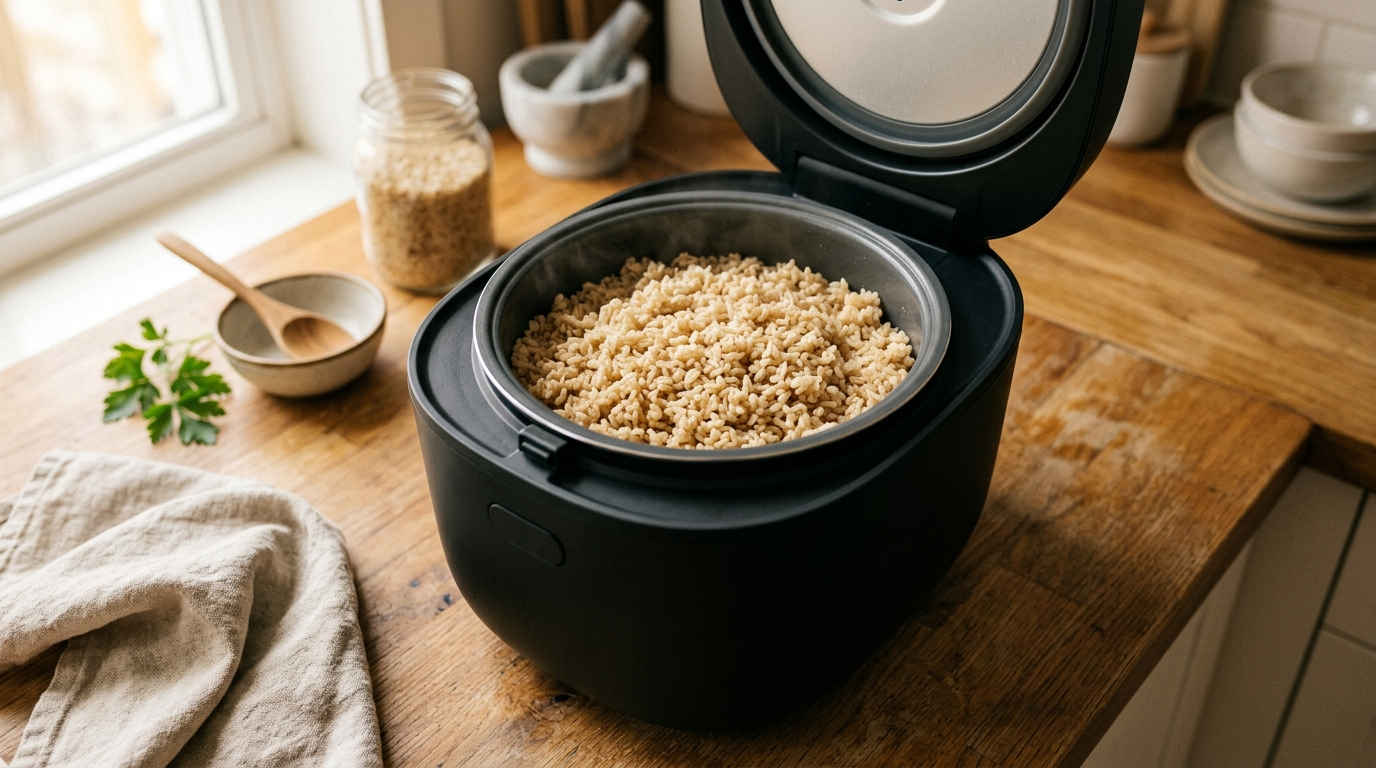
Lost your measuring cup? The rice cooker knuckle (finger-joint) method gets the water level right by feel. Here's how it works, why it's surprisingly reliable, and how to adjust it for white, brown, and long-grain rice.
Disclosure: As an Amazon Associate, Fuzzy Logic Rice Cooker earns from qualifying purchases made through links on this page.
The measuring cup that came with your rice cooker has a habit of disappearing. It slides behind the spice rack, gets lost in a drawer, or quietly migrates to a camping box and never returns. That leaves you with a pot of rinsed rice and an obvious question: how much water do you add?
For generations of home cooks, the answer has been the same simple trick — reach for your hand instead of a cup. The rice cooker knuckle method (also called the finger-joint method) is a quick, sensory way to land on a workable water level when you don’t have — or don’t want to bother with — a measuring cup.
This guide explains exactly how to do it, why it tends to work as well as it does, and — importantly — when you shouldn’t trust it. It’s a practical fallback, not a magic formula, and knowing its limits is what separates rice that comes out right from rice that’s mushy or crunchy.
What Is the Rice Cooker Knuckle Method?
The knuckle method is a way of gauging the depth of water above the rice rather than measuring the water by volume. Instead of counting cups, you use the length of your index finger as a rough ruler.
The idea is straightforward: rice absorbs water in proportion to how much rice there is. So rather than measuring the water separately, you let the layer of rice itself define the starting line, and you only measure the small cushion of water sitting on top of it. Your finger — specifically the distance from the fingertip to the first crease — gives you a consistent, repeatable way to estimate that cushion.
It’s not new, and it’s not a secret. Variations of the technique are used across many rice-eating cultures and are taught informally in home kitchens. What makes it useful in a rice cooker specifically is that the cooker then takes over the timing and temperature control, smoothing out small inaccuracies in your water level.
How to Do It, Step by Step
The method only takes a few seconds, but each step matters more than people expect.
- Rinse the rice first. Rinsing removes surface starch that makes cooked rice gummy, and it also changes how much water clings to the grains. A consistent rinse means a more consistent result. Drain the rinsing water as fully as you reasonably can before measuring.
- Level the rice in the pot. Shake or tap the inner pot so the rice settles into an even, flat layer. The whole method depends on the rice bed being roughly level — if one side is piled high and the other is shallow, your finger reading will be off.
- Touch the tip of your index finger to the surface of the rice. Stand your finger straight up and down so the fingertip just rests on top of the rice. Use the same finger every time, since finger length varies from person to person.
- Add water until it reaches your first knuckle crease. That’s the first joint line down from the fingertip — for most adults, roughly half an inch or so of water standing above the rice. Stop there.
- Cook as usual. Close the lid and start the cycle. Fluff gently when it’s done.
That’s the entire technique. It sounds almost too simple to work, and that’s fair skepticism — so it’s worth understanding why it tends to come out reasonably well.
Why the Knuckle Method Works (and Where It Comes From)
There’s no precise science behind the knuckle method — it’s a folk heuristic — but there is a sensible reason it lands in the right neighborhood for a typical home batch.
Rice needs water both to hydrate the grain and to replace what evaporates during cooking. The amount it needs scales with the quantity of rice. When you measure water as a fixed depth above a level bed of rice, you’re implicitly tying the water to the rice volume in the same way a ratio does — just less precisely.
For the small-to-moderate quantities most people cook in a home rice cooker (say, one to a few cups of dry rice), the geometry lines up: the finger-joint depth happens to fall in a range that produces acceptable rice. The rice cooker then does a lot of the forgiving work. A fuzzy-logic or micom cooker senses temperature and moisture and adjusts heat and time, which compensates for small over- or under-measurements that would ruin rice on a basic on/off cooker.
This is also why the method isn’t universal: it’s calibrated, loosely, to ordinary home batch sizes and ordinary pot proportions. Push it outside that range and the approximation breaks down. For a more precise, repeatable approach — especially when it matters — measuring by weight or with the cooker’s graduated lines is more reliable. Our water-to-rice ratio guide walks through exact ratios by rice type if you’d rather skip the estimating.
Adjusting the Method for Different Types of Rice
The default knuckle mark is essentially tuned for medium- and short-grain white rice, the kind most commonly cooked in a basic rice cooker. Different rices want different treatment, so you’ll want to nudge the level up or down depending on what’s in the pot.
- Long-grain white, jasmine, and basmati rice prefer a slightly lower water level for separate, fluffy grains. Fill just below the first crease. These rices also do well rinsed gently and can benefit from a brief rest after cooking. For a full breakdown, see our guide to brown rice in a rice cooker and the ratio guide linked above.
- Brown rice is whole-grain rice with the bran and germ still intact, and that bran layer slows water absorption. Brown rice needs more water and a longer cook — aim slightly above the first crease, closer toward the second joint, and expect a longer cycle. (Brown rice counts as a whole grain under U.S. dietary guidance from USDA MyPlate.)
- Sushi rice and other short-grain white rice are what the default mark was built for, so the standard first-crease level is a good starting point.
- Older rice or rice that’s sat in the pantry a long time can be drier and may need a touch more water than fresh rice of the same type.
When in doubt, lean slightly toward less water for long-grain and slightly toward more for brown — you can always adjust next time. For a broader reference on rice varieties and their characteristics, the USA Rice Federation publishes consumer resources through its Think Rice program.
When the Knuckle Method Lets You Down
The method has real failure modes, and it’s worth naming them so you know when to fall back on actual measurement.
- Very small or very large batches. The heuristic is built around typical home quantities. A single serving or a nearly full pot can throw off the rice-to-water relationship the method assumes.
- Pots with unusual proportions. A tall, narrow inner pot and a short, wide one will read differently even with the same finger depth, because the same depth of water covers a different amount of rice.
- Inconsistent leveling. If you don’t flatten the rice bed, you’re measuring against a slanted surface and the reading is meaningless.
- Switching fingers or cooks. The “first crease” depth varies from person to person. If one household member has much longer fingers than another, results will drift unless everyone uses the same approach.
For everyday weeknight cooking of standard white or brown rice in a normal batch, these caveats rarely bite. For a special meal or an unfamiliar rice, measure instead. If you’re new to rice cookers generally, our how to use a rice cooker guide covers the cup, the inner-pot water lines, and the basic cycles.
How Fuzzy Logic Cookers Make the Method More Forgiving
Here’s the part that makes the knuckle method genuinely practical on this site’s kind of cooker: fuzzy logic and induction rice cookers are designed to compensate for exactly the kind of small errors this method introduces.
A basic rice cooker is essentially a single-switch device — it heats until the water is absorbed and the temperature rises past boiling, then switches to warm. It can’t tell whether you gave it a little too much or too little water; it just runs its cycle, and the result reflects your measurement directly.
A fuzzy-logic (micom) cooker, by contrast, runs a small program that reads the internal temperature and adjusts heat and timing as it goes. Some add induction heating for even finer control. That adaptiveness is what forgives the knuckle method’s imprecision: a slightly-too-wet or slightly-too-dry pot gets nudged toward a good outcome rather than turning out soggy or undercooked.
The catch is that no cooker can rescue a wildly wrong water level. Fuzzy logic forgives small errors; it can’t turn a half-empty pot into a full one. Use the knuckle method as a reasonable estimate, let the cooker do its compensating, and reserve exact measurement for when precision matters.
If you’re shopping for a cooker that will be lenient with fingertip measuring, a well-known fuzzy-logic model like the Zojirushi NS-ZCC10 is the kind of micom cooker this method pairs well with.
Storing and Reheating Leftover Rice Safely
Cooking the right amount of water is only half the job. Once rice is cooked, how you handle the leftovers matters for safety, not just texture — and this is one area where folk habit and food-safety guidance part ways.
Uncooked rice can carry spores of Bacillus cereus, a bacterium that can cause food poisoning, and those spores can survive the cooking process. If cooked rice is left sitting at room temperature, the spores can grow into bacteria that produce toxins — and those toxins are what actually make you sick, not the reheating itself. According to the UK NHS guidance on reheated rice, the risk grows the longer cooked rice sits out, and symptoms can include vomiting within roughly half an hour to six hours, or diarrhoea several hours later.
The practical rules that follow from this are simple:
- Serve rice as soon as it’s cooked when you can.
- Cool leftovers quickly — the NHS advises aiming to cool cooked rice within about an hour.
- Refrigerate promptly and keep it for no more than about a day before reheating.
- Reheat until it’s steaming hot all the way through, and don’t reheat rice more than once.
For day-to-day storage tips beyond food safety, our rice storage guide covers containers, pantry shelf life, and keeping cooked rice at its best.
Frequently Asked Questions
Does the knuckle method work for brown rice? It works as a starting point, but brown rice needs more water than the default mark suggests because the bran layer absorbs slowly. Fill a little above the first crease and plan for a longer cook cycle. See our brown rice in a rice cooker guide for specifics.
Which finger do I use? Your index finger, held straight up and down with the tip resting on the leveled rice. Use the same finger each time for consistency.
Is the knuckle method as accurate as a measuring cup? No — it’s an approximation. It’s reliable enough for everyday white and brown rice in normal batch sizes, especially in a fuzzy-logic cooker, but for precision or unfamiliar rices, measuring by the cup or weight is better.
Why does my rice still come out wrong sometimes? Usually because the rice wasn’t leveled, the batch was unusually small or large, or the pot’s proportions differ from what the method assumes. Rinsing consistency and the rice’s age also play a role.
Where can I find more rice cooker basics? Our rice cooker FAQ and how to use a rice cooker guides cover the common questions in more depth.
The Bottom Line
The knuckle method is a genuinely useful tool to have in your back pocket. It won’t replace careful measurement when precision counts, but for the everyday situation — missing cup, weeknight dinner, familiar rice — it gets you close enough that a good fuzzy-logic cooker can take you the rest of the way.
The keys to making it work are the unglamorous ones: rinse consistently, level the rice bed, use the same finger, and adjust the level for the rice type. Add the food-safety habit of cooling and refrigerating leftovers promptly, and you’ve got a simple routine that covers both how the rice turns out and whether it’s safe to eat the next day.
Keep a measuring cup handy when it matters. But when it doesn’t — and often it doesn’t — your finger is a fine substitute.
Related Articles
How to Cook Rice in an Instant Pot: Perfect Every Time
Foolproof Instant Pot rice ratios for white, brown, jasmine, and basmati. Plus a rice cooker vs. Instant Pot comparison to help you decide which makes better rice.
how-toAroma Rice Cooker Instructions: Water Ratios, Settings and That Little Cup, Explained
The Aroma measuring cup is not a cup, the water lines are not ounces, and the manuals assume you know both. Ratios by rice type and model line, settings decoded, and the mistakes that ruin batches.
how-toRice Cooker Instructions: How to Use Any Rice Cooker (Beginner Guide)
Never used a rice cooker? This guide covers every type, every rice, and every common mistake, regardless of which brand you own.