
Yum Asia Kumo YumCarb Review: A Low-Carb Fuzzy Logic Cooker Worth the Counter Space?
"Genuinely great fuzzy-logic rice and a unique low-carb mode, but recurring durability and condensation-drainage complaints hold it back."
As an Amazon Associate we may earn a commission from qualifying purchases made through links on this page, at no extra cost to you.
The Yum Asia Kumo YumCarb (model YUM-EY10DUS, ASIN B09TYTRN5K) is one of the more unusual fuzzy-logic rice cookers you can buy in North America. It is a compact 5.5-cup (1-litre) Micom cooker wrapped in a dark stainless shell, with a PTFE-free ceramic inner bowl — and it has one trick almost no rival offers: a dedicated YumCarb program that the manufacturer says reduces the carbohydrate content of cooked rice by up to 25%.
That last claim is the whole reason most people find this cooker, so this review spends real time on it. Rather than hands-on lab testing, what follows is a synthesis of the manufacturer’s published specifications and the consensus that emerges from verified buyer reviews — what owners consistently love, what they gripe about, and where the Kumo YumCarb genuinely fits in a crowded field of budget and mid-range fuzzy-logic cookers.
What the Yum Asia Kumo YumCarb actually is
Yum Asia is a British-designed, Asian-built brand that has built its reputation around bringing fuzzy-logic cooking to the UK, European, and US markets. The Kumo sits in the middle of its line: bigger than the tiny 3.5-cup Panda Mini, smaller than the 8-cup Yum Asia Sakura, and — uniquely — the only one in the family with the low-carb YumCarb program.
In everyday terms, it is a small-footprint cooker aimed at singles, couples, and small families of one to five people. According to the manufacturer’s product listing, it uses 3D surround heating driven by an advanced fuzzy-logic processor, cooks across five rice programs and three multi-cooker programs, and holds a 4.5-star average across more than 400 ratings on Amazon at the time of writing.
Key specs at a glance
| Specification | Detail |
|---|---|
| Capacity | 5.5 cups uncooked rice (1 litre); suited to 1–5 people |
| Power | 500 W, 110–120 V with a detachable US cord |
| Heating | 3D surround heating with advanced fuzzy logic (Micom) |
| Inner bowl | 5-layer, 2 mm “Ninja” ceramic coating — PTFE- and BPA-free |
| Rice programs | White/long grain, short grain/sushi, brown, YumCarb white, YumCarb brown |
| Multi programs | Steam, porridge, slow cook |
| Convenience | 24-hour keep warm, 24-hour preset timer, 10-minute final countdown |
| Included extras | Stainless YumCarb/steamer tray, measuring cup, rice spatula, soup ladle |
| Warranty | 2-year manufacturer warranty |
| Footprint | ~10.6 × 10.6 × 10.2 in, roughly 2 kg |
How the YumCarb setting actually works
This is the feature that justifies the Kumo’s existence, so it is worth understanding honestly. YumCarb is not a coating or an additive — it is a different way of running the cook cycle, and it depends on the included stainless-steel tray.
According to the manufacturer’s description, when you use a YumCarb program the rice goes into the perforated stainless tray and is submerged in water at the start of the cycle. The cooker holds a relatively low temperature for the first phase, which gives starch time to leach out of the grains and dissolve into the surrounding water. Because that starchy water then drains down through the holes in the tray and away from the rice, those dissolved starches are not reabsorbed the way they are in a normal cook. The rice finishes by steaming in that lowered-carbohydrate state for the final stretch.
The brand attributes a specific number to this: a reduction of up to 25% fewer carbohydrates in white rice, citing lab testing by the Testing Institute of Product Quality Supervision in China. Treat that figure as the manufacturer’s claim rather than an independently verified measurement — it is their number, produced under their stated test conditions, and your real-world results will depend on rice type, water volume, and how faithfully you follow the tray method. The underlying principle, though — that draining starchy water away from the grain lowers the digestible-starch load of the finished rice — is sound and is the same logic behind stovetop “excess-water” rice cooking.
A practical heads-up drawn straight from owner reviews: the YumCarb timer is confusing. The display parks at 0:20 (white rice) or 0:40 (brown rice) for the entire first phase and only begins counting down during the final 20 minutes. Several buyers found this nerve-wracking at first, assuming the cooker had stalled. It hasn’t — that behavior is by design.
The Ninja ceramic bowl: PTFE-free cooking
The other headline feature is the inner bowl itself. Yum Asia calls its 5-layer, 2 mm-thick coating “Ninja ceramic,” and the brand is explicit that it is PTFE-free and BPA-free — meaning there is no Teflon-style nonstick polymer on the cooking surface.
That matters to a growing number of shoppers. Concerns around PFAS, the broad family of “forever chemicals” that includes fluoropolymers such as PTFE, have pushed many people toward ceramic and bare-stainless cookware. If you are specifically trying to move away from coated nonstick bowls, the Kumo’s ceramic pot is a genuine selling point rather than marketing spin — and it is the reason quite a few buyers say they chose this cooker over a Tiger or a coated Cuckoo.
In use, owners consistently describe the bowl as easy to clean, with rice releasing cleanly and a quick wipe often being enough. The bowl carries silk-screened water-level lines for different grain types, and the outer steam cap and condensation collector are removable. The matching stainless tray earns praise too: several reviewers use it to wash and drain rice before cooking, since the holes are small enough to hold the grains while letting water pass through — a nice two-birds-one-stone detail.
Fuzzy-logic performance: what owners actually say about the rice
This is where the Kumo wins people over. The dominant theme across verified reviews is that the rice — particularly white rice, basmati, and short-grain — comes out genuinely excellent: fluffy, evenly textured, and frequently described as “restaurant quality.” Reviewers who came from cheap one-button cookers or saucepan cooking tend to be the most enthusiastic, reporting that the fuzzy logic removes the guesswork around water ratios and grain type.
The cooker runs a multi-phase cycle (preheat, absorb water, heating, boiling, steaming, cool-down, and keep-warm), and a 10-minute countdown on the display tells you when service is imminent — a small touch that owners appreciate for meal timing. The 24-hour keep-warm and 24-hour preset timer both get positive mentions, especially from people who set up oatmeal the night before.
Brown rice is more divisive. Some owners praise the brown-rice texture as fluffy and never soggy; others report it finishing crunchy even after the full 60-minute cycle, requiring extra time. Brown rice is always the hardest grain for a small fuzzy-logic cooker to nail, and if perfectly tender brown rice is your main goal, it is worth comparing against picks in our dedicated Best Rice Cooker for Brown Rice & GABA guide.
Versatility beyond plain rice
The Kumo is more than a one-trick cooker. Beyond the five rice programs, it offers steam, porridge, and slow-cook modes, and the included stainless tray turns it into a capable steamer for vegetables, dumplings, or fish sitting above the rice. Owners report good results with oatmeal and rice porridge, and the manufacturer notes the cooker also handles other grains — quinoa, couscous, millet, and pearl barley — well. If you cook a rotating cast of whole grains rather than just white rice, that flexibility is a real plus, and it places the Kumo in conversation with the options in our Best Rice Cooker for Multigrain and Mixed Grains round-up.
One honest caveat about versatility: at 500 W and 1 litre, this is a small, comparatively low-powered machine. It is not built to feed a crowd or to power through large batches quickly. Fuzzy-logic cycles are also inherently longer than a basic on/off cooker — plan for roughly 40–60 minutes for most rice programs.
Where owners say the Kumo falls short
No honest review of this cooker can skip the gripes, because they cluster around a few specific, repeatable issues.
Condensation drainage is the number-one complaint. A meaningful share of owners report that when they open the lid after a cook, a “waterfall” of accumulated condensation runs off the underside of the inner lid and straight onto the counter. Some tie this to the steam cap or condensation collector falling out of position over time. It is messy rather than dangerous, but it is a daily annoyance for affected owners.
The inner lid is not removable on this model, which several buyers contrast unfavorably with cookers whose inner lids pop out for scrubbing. Because rice starch splatters and bakes onto a fixed lid, keeping it clean takes more effort.
Durability is the most serious concern. While many units run for years without trouble, there is a clear minority of reviews describing failures after several months of use — recurring E2 error codes, units that stop heating, and buttons that stop responding. Yum Asia’s two-year warranty is better than the category norm and is worth keeping in mind, but the pattern is real enough that it pulls our editorial rating down from where the raw Amazon average sits.
A few smaller gripes round out the picture: the included water-to-rice ratios are reportedly “a bit off” and need personal tuning, the steam vent must seat perfectly or rice can come out mushy, and opinions on value are genuinely split — some call it a great deal, others feel it is overpriced for a 1-litre cooker.
Who should buy the Kumo YumCarb (and who should skip it)
It’s a strong fit if you cook for one to five people, you want genuinely good fuzzy-logic rice without paying induction-heating prices, you are specifically trying to avoid PTFE coatings, and — most of all — the idea of a built-in low-carb rice mode genuinely appeals to you. For carb-conscious eaters, diabetics managing rice intake, or anyone who finds regular cooked rice too starchy, the YumCarb program is a feature no comparable rival offers in quite this way.
Skip it if you regularly cook for a larger family, you want the absolute fastest rice, you need induction-level brown-rice performance, or a non-removable inner lid and the potential for condensation mess would genuinely bother you. If any of those apply, the bigger sibling Yum Asia Sakura (8-cup, with a “crust” function but no YumCarb) or a dedicated fuzzy-logic pick may serve you better.
Frequently asked questions
Does the YumCarb function really reduce carbs? Based on the manufacturer’s cited lab testing, white rice cooked on the YumCarb program contains up to 25% fewer carbohydrates than conventionally cooked rice. That is the brand’s own figure from its stated test conditions, not an independent measurement, so treat it as a best-case claim. The underlying starch-draining mechanism is sound, and most owners who use the feature are satisfied, but your results will vary with rice type and water volume.
Is the ceramic bowl truly nonstick and PTFE-free? Yes — the 5-layer “Ninja” bowl is explicitly PTFE- and BPA-free, with no Teflon-style polymer coating. Owners still describe it as releasing rice cleanly and being easy to wipe out, though like any ceramic surface it is best washed gently (the brand notes hand-washing) to avoid scratching.
How big is it really? It is a 5.5-cup (1-litre) cooker designed for one to five people, with a small countertop footprint of roughly 10.6 × 10.6 × 10.2 inches. Several owners were surprised by how compact it is, so check the dimensions if you cook larger batches.
Is it good for brown rice? Mixed. Some owners love the fluffy brown-rice results; others find it finishes crunchy and needs extra time. Brown rice is the Kumo’s weakest grain, so weigh that against your priorities.
How long does a cook take? Fuzzy-logic cycles are slower than basic cookers — roughly 40–60 minutes for most rice, with YumCarb white rice around 40 minutes. The 10-minute countdown and 24-hour timer help you plan around that.
The bottom line
The Yum Asia Kumo YumCarb is a genuinely interesting cooker rather than just another Micom box. It produces the excellent, forgiving rice that fuzzy logic is famous for, its ceramic bowl is a real draw for anyone avoiding PTFE coatings, and the YumCarb program is a legitimately unique feature for people who want lower-carb rice without changing what they eat. The accessories and 2-year warranty round out a thoughtful package.
What holds it back from a higher score is consistency. The condensation-drainage issue, the non-removable inner lid, and a real cluster of durability complaints — especially E2 errors after months of use — mean it is a cooker you should buy with eyes open, ideally testing all the buttons early within the return window. If those risks are acceptable to you and the low-carb mode speaks to your needs, the Kumo YumCarb is a distinctive, capable choice that earns its counter space. If they aren’t, the wider Yum Asia line or a more established fuzzy-logic brand may be the safer bet.
You can check current pricing and availability for the Yum Asia Kumo YumCarb on Amazon → view the listing (ASIN B09TYTRN5K). Amazon leads with the YumCarb carb-reduction claim. Our listing check is whether that program is a real heat/rinse cycle or a label, and how the ceramic bowl holds up versus a standard non-stick Micom.
Related: Low Carb Rice Cooker: How to Cut Carbs Without Giving Up Rice.
✅ Pros
- Restaurant-quality white, brown, and basmati rice from advanced fuzzy logic (Micom)
- Unique YumCarb mode the maker says lowers rice carbohydrates by up to 25%
- PTFE- and BPA-free 5-layer 'Ninja' ceramic inner bowl — no Teflon-style coating
- Compact 5.5-cup (1-litre) footprint sized for 1–5 people and small kitchens
- Versatile: steam, porridge, and slow-cook programs plus a 24-hour keep-warm and timer
- Easy-to-clean ceramic bowl; the stainless tray doubles as a handy rice washer
❌ Cons
- Condensation 'waterfall' runs off the inner lid onto the counter when you open it
- Inner lid isn't removable on many units, so trapped starch is hard to wipe out
- A real cluster of durability complaints — E2 errors and failures after several months
- Water-to-rice ratios need trial and error, and brown rice can finish crunchy
- The YumCarb timer is opaque — it parks at 0:20, then jumps to done
- Only 500 W and 1 litre; too small and slow for bigger households
🍚 You Might Also Like
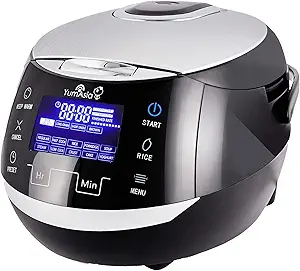
Yum Asia Sakura Rice Cooker Review: Worth It?
The Yum Asia Sakura is a strong mid-range fuzzy logic rijstkoker if you want an 8-cup ceramic-bowl cooker for daily white rice, sushi rice, brown rice, porridge, steaming, and slow cooking.
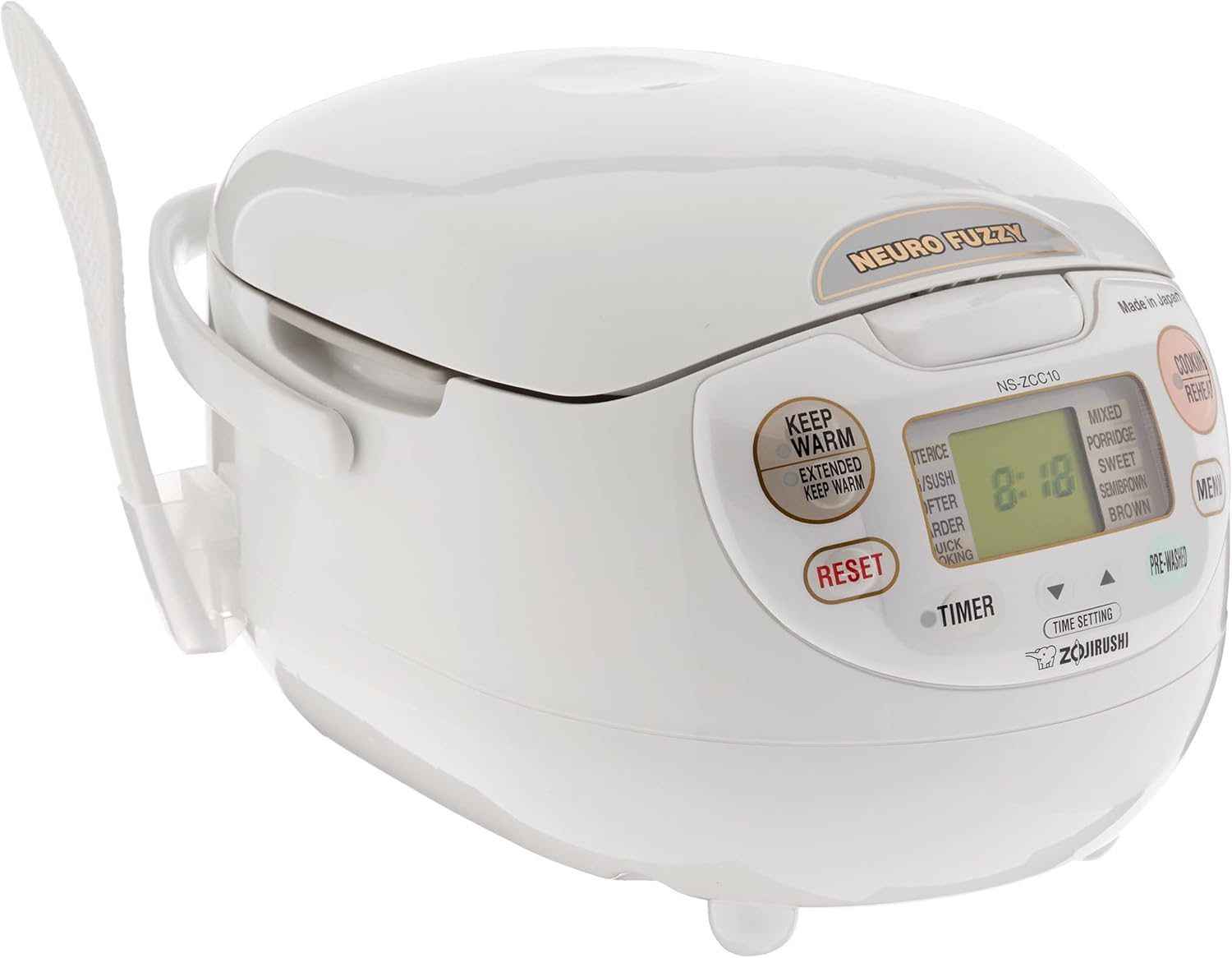
Best Rice Cooker for Brown Rice & GABA - Top Picks
Brown rice requires patience and precision. A fuzzy logic cooker with a dedicated GABA brown rice mode makes all the difference. Our top pick is the Zojirushi NS-ZCC10.
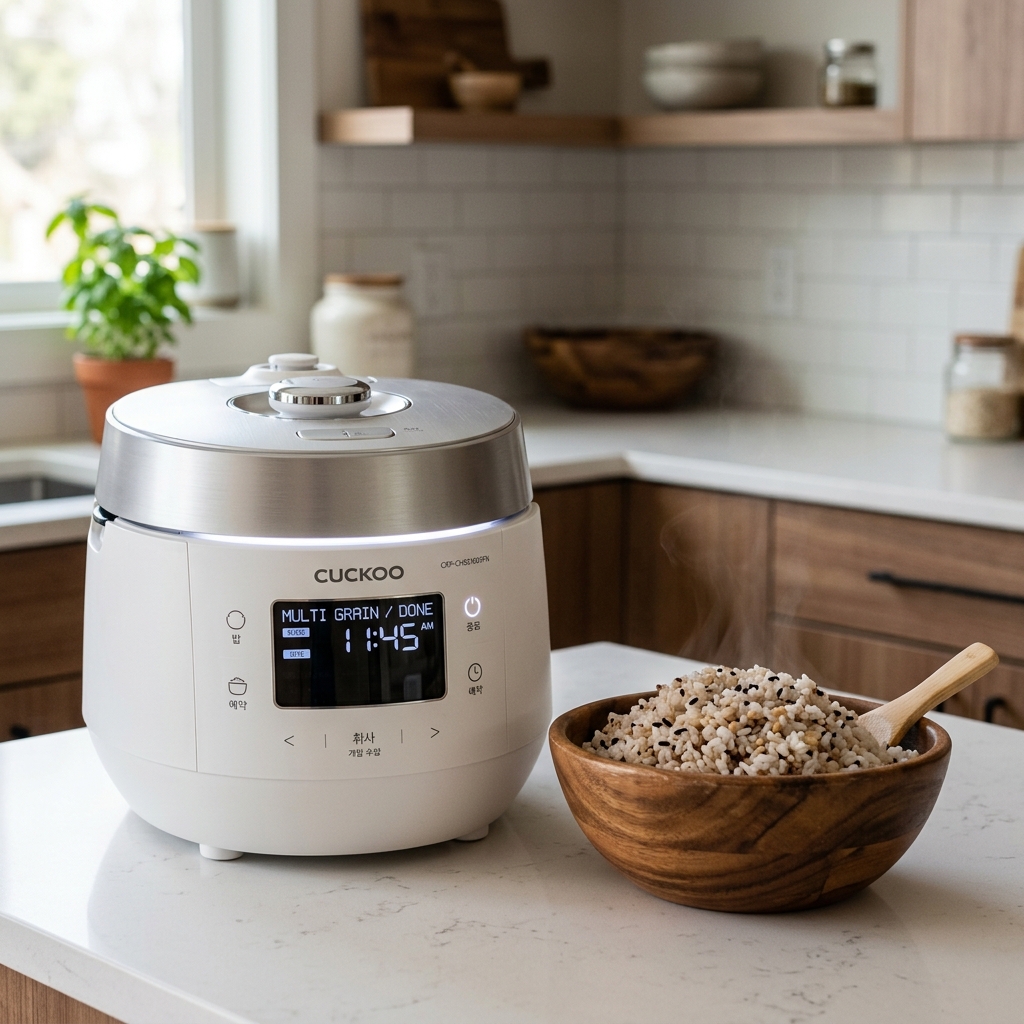
Best Rice Cooker for Multigrain and Mixed Grains
For multigrain cooking, pressure IH cookers like the Cuckoo CRP-ST1009FG deliver the best results because pressure forces moisture through dense grains evenly. The Zojirushi NS-ZCC10 is the best non-pressure alternative.
Ready to Upgrade Your Rice Game?
The Yum Asia Kumo YumCarb (YUM-EY10DUS) is waiting for you. Perfect rice, every time.
Buy on Amazon 🍚 🛒