
How Much Cooked Rice Does 1 Cup of Uncooked Rice Make?
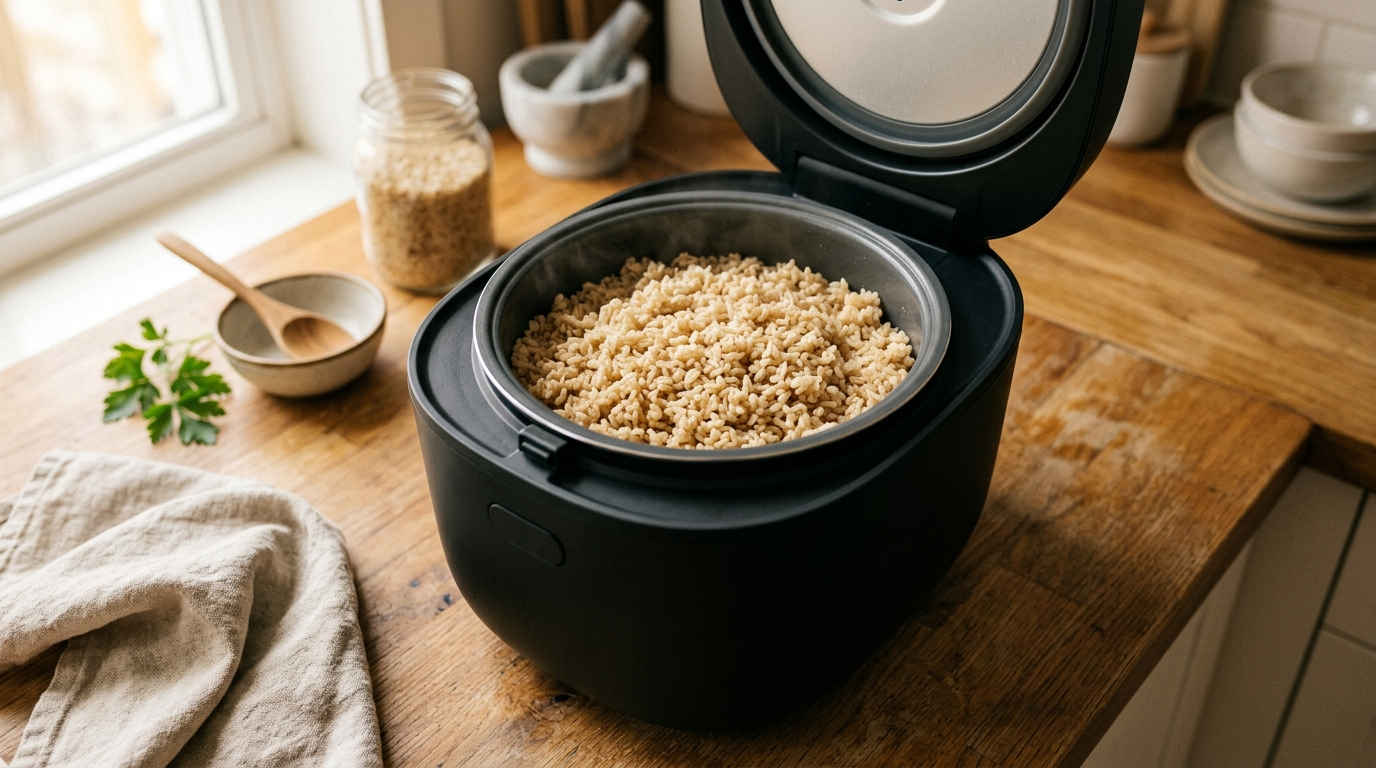
One cup of uncooked rice yields about 3 cups cooked for most white varieties, but the real ratio depends on the type. Here's the yield breakdown for white, jasmine, basmati, brown, and sushi rice—plus how to size your cooker.
As an Amazon Associate we may earn a commission from qualifying purchases made through links on this page, at no extra cost to you.
It’s the question that follows every rice purchase: you measure out one cup of dry rice, and somewhere between the steam and the keep-warm cycle you’re either staring at a mountain of leftovers or scraping the pot for seconds. So how much cooked rice does 1 cup of uncooked rice actually make?
The short, honest answer: for most white rice, 1 cup uncooked yields about 3 cups cooked. But that tidy 3× ratio only holds for certain varieties. Brown rice, basmati, and short-grain sushi rice each behave differently, and the measuring cup that came with your rice cooker isn’t the cup you think it is.
This guide breaks down cooked-rice yield by variety, explains why the math works the way it does, and shows how to translate those numbers into the right cooker size for your household. It’s a research-based summary of manufacturer documentation and the U.S. food-composition database—no test kitchen required.
The quick-reference table
Before the nuance, here’s the yield you can plan around for one standard U.S. dry-measuring cup (240 ml) of uncooked rice. The ranges reflect common cooking guidance from sources like USA Rice alongside the USDA composition data cited below:
| Rice variety | 1 cup uncooked → | Approx. multiplier |
|---|---|---|
| Long-grain white | ~3 cups cooked | 3× |
| Jasmine | ~3 cups cooked | 3× |
| Basmati | ~3 to 3½ cups cooked | ~3× |
| Brown | ~3 to 4 cups cooked | 3–4× |
| Sushi / short-grain white | ~2½ cups cooked | ~2.5× |
These are by-volume estimates, and they assume you’re cooking with roughly the water ratio each variety likes. Cook with less water and you get less volume (and firmer grains); cook with more and the yield creeps up—but the texture suffers long before the math does.
Why a cup of rice turns into three
Rice roughly triples in volume because of what happens when starch meets water. Raw white long-grain rice is only about 12% water by weight; once cooked, it’s closer to 68% water, according to the USDA FoodData Central composition entries for raw and cooked rice. The grains are mostly absorbing water and swelling, not creating new mass.
You can sanity-check the 3× number with weight. A level U.S. cup of raw long-grain white rice weighs about 185 g; a cup of the same rice cooked weighs roughly 158 g. Three cooked cups (about 474 g) minus the 185 g of raw rice leaves close to 290 g of absorbed water—within shouting distance of the 1½ to 1¾ cups of water most recipes call for, with the rest lost as steam. That’s the whole “trick”: the extra volume is water the grains hold onto.
Brown rice follows the same physics but starts with its bran and germ layers intact. Those layers hold extra moisture, so a cup of brown rice often drinks more water and can push the cooked yield toward 3½ or even 4 cups if you cook it on the softer side—though it stays denser per cup than white rice.
The rice-cooker cup trap (read this before you measure)
Here’s where most people’s yield math goes sideways. The plastic cup that ships with a fuzzy logic rice cooker is not an 8-ounce U.S. measuring cup. It’s a gō (合), the traditional Japanese rice measure, and it holds roughly 180 ml—about three-quarters of a standard U.S. cup. Zojirushi, Tiger, Cuckoo, and other makers all use this same ~180 ml cup, as Zojirushi’s rice cooker documentation explains.
That detail matters for two reasons:
- If a recipe written for U.S. cups tells you to cook “1 cup of rice,” and you scoop with the cooker cup, you’re actually cooking about ¾ cup. Your yield will come up short.
- When a cooker is advertised as a “5.5-cup” model, those are 180 ml cups, not U.S. cups. A 5.5-cup cooker holds about 1 liter of raw rice at its rated line, which expands to roughly 16 of those small cups of cooked rice—enough for a family.
So “1 cup uncooked” means one thing in a Western recipe (240 ml) and a smaller thing (180 ml) when you’re reading the lines stamped inside your cooker’s inner pot. Match the cup to the recipe, and use the markings on the pot for water, not a measuring cup.
Yield by variety: what to expect
White long-grain
The reliable 3× benchmark. One U.S. cup of raw long-grain white rice—think standard American supermarket long-grain—cooked with about 1¾ cups water gives you close to 3 fluffy cups. This is the variety most “1 cup equals 3 cups” rules of thumb are built on.
Jasmine
Slightly shorter, softer, and more fragrant than generic long-grain, jasmine still lands near 3 cups cooked per cup raw. It needs a touch less water than long-grain (about 1½ cups), and because the grains are tender, overcooking can turn the yield gummy rather than plentiful. If you cook a lot of jasmine, our jasmine vs. basmati breakdown covers how the two differ beyond the yield.
Basmati
Basmati elongates more than any other common variety, so a cup of dry basmati can stretch to 3 or even 3½ cups cooked, with long, distinct grains. It also wants less water—around 1½ cups per cup of rice—and benefits from a brief rinse and soak. For cooker settings tuned to long, separate grains, see our guide to the best rice cookers for basmati.
Brown
Brown rice’s bran layer slows water absorption, so it takes longer and more water, and its cooked yield is the least predictable—anywhere from 3 to 4 cups depending on whether you like it chewy or soft. Expect a denser, heavier cup than white. Our brown rice in a rice cooker walk-through covers water ratios and timing for getting it tender instead of crunchy.
Sushi / short-grain white
Short-grain rice is starchier and plumper, so it expands less by volume—closer to 2½ cups cooked per cup raw. That extra starch is exactly what gives sushi rice its cling, which is why the lower volume is a feature, not a problem. Our picks for the best rice cooker for sushi rice are tuned for that sticky texture.
What changes the yield
The 3× figure is a target, not a law. Several variables nudge the final volume up or down:
- Water ratio. The single biggest lever. More water means more volume, until the rice turns to paste. Fuzzy logic and induction cookers manage this automatically once you fill to the pot’s marked line; basic cookers need you to measure.
- Rinsing. Rinsing removes surface starch, which slightly reduces clumping and can marginally increase fluffiness and apparent volume.
- Altitude. Water boils at a lower temperature up high, so rice absorbs less heat and often needs more water or time. Our high-altitude rice cooker guide has the adjustments.
- Cooker type. Pressure and induction cookers can drive more complete starch gelatinization, sometimes yielding slightly more tender (and marginally more voluminous) rice than a basic on/off model. The trade-offs are laid out in our induction rice cooker and fuzzy logic vs. micom comparisons.
- Soaking. A short soak lets grains hydrate evenly before cooking, which can improve texture more than raw volume.
Translating yield into the right cooker size
This is where “1 cup equals 3 cups” stops being trivia and starts being a buying decision. If one U.S. cup of raw white rice gives you about three cups cooked, and a typical adult side portion is around one cooked cup, then a single cup of dry rice feeds roughly three people as a side dish (fewer if rice is the main event).
Work backward from your household:
- 1–2 people, light eaters: a 3-cup (rice-cooker-cup) model is plenty.
- Family of 4: a 5.5-cup model hits the sweet spot for most meals.
- Big batches, meal prep, or guests: step up to a large-capacity cooker.
Our full rice cooker size guide walks through the math for every household size. If you already know you want a fuzzy logic cooker and just need a reliable, well-reviewed model, the Zojirushi NS-ZCC10 (a 5.5-cup Neuro Fuzzy model) is one of the most commonly recommended options in owner reviews for households of 3–4.
Leftovers: storing the extra two cups
Because one cup of raw rice so often produces more than you’ll eat, storage matters. Cooked rice is a well-known host for Bacillus cereus, a bacterium whose heat-resistant spores survive cooking; food-safety guidance recommends refrigerating cooked rice within about two hours (one hour if your kitchen is hot) and using it within a few days. Let the rice cool briefly, then transfer it to an airtight container and chill it—don’t leave it on the keep-warm cycle overnight. Our rice storage guide covers safe reheating and how long cooked rice really lasts.
Frequently asked questions
How many people does 1 cup of uncooked rice serve? As a side dish, about two to three adults—one cup raw becomes roughly three cups cooked, and a typical side portion is around one cooked cup. If rice is the centerpiece (with curry or stir-fry, for example), plan on it serving one to two.
Does 1 cup of uncooked rice always make 3 cups cooked? Only for most white long-grain, jasmine, and basmati. Brown can reach 3 to 4 cups, and short-grain sushi rice is closer to 2½ because of its higher starch and lower expansion.
Why does the cup that came with my rice cooker look small? It’s a gō, roughly 180 ml, or about ¾ of a U.S. cup. Cooker capacity ratings (a “5.5-cup” cooker) are in these 180 ml units, not U.S. cups.
Is it better to measure rice by weight? It’s more consistent. A kitchen scale removes the “which cup?” problem entirely: about 185 g of raw long-grain white rice yields roughly 3 cups cooked. Serious cooks often weigh; most households do fine with the right volume cup.
The bottom line
One cup of uncooked rice gives you about three cups cooked for the white varieties most people make—long-grain, jasmine, and basmati—with brown stretching toward four and short-grain sushi rice landing nearer two and a half. The multiplier is water: raw rice is mostly dry starch, and cooking is largely the grains soaking it up.
The two things that throw people off are the variety (brown and short-grain don’t triple the same way) and the rice-cooker cup, which is 180 ml, not 240 ml. Get those right, and you can size your cooker, plan your portions, and skip both the leftover mountain and the empty-pot disappointment.
Related Articles
Rice Cooker Cup Size in ml: Why the Included Cup Is 180 ml
The cup that comes with a rice cooker is 180 ml, not a 240 ml US cup. Here's why it's a Japanese gō, how that throws off your water-to-rice ratio, and how to convert rice cooker cups to standard cups.
educationalLow Carb Rice Cooker: How to Cut Carbs Without Giving Up Rice
Low-carb rice cookers use a drain basket to separate starch water. Here's whether they actually work and what alternatives exist.
educationalWhat is a Neuro Fuzzy Logic Rice Cooker?
We break down the science behind neuro fuzzy logic technology and why a microchip is the secret to perfect, restaurant-quality rice.