
Panasonic Rice Cookers: Which Model Fits Your Kitchen?
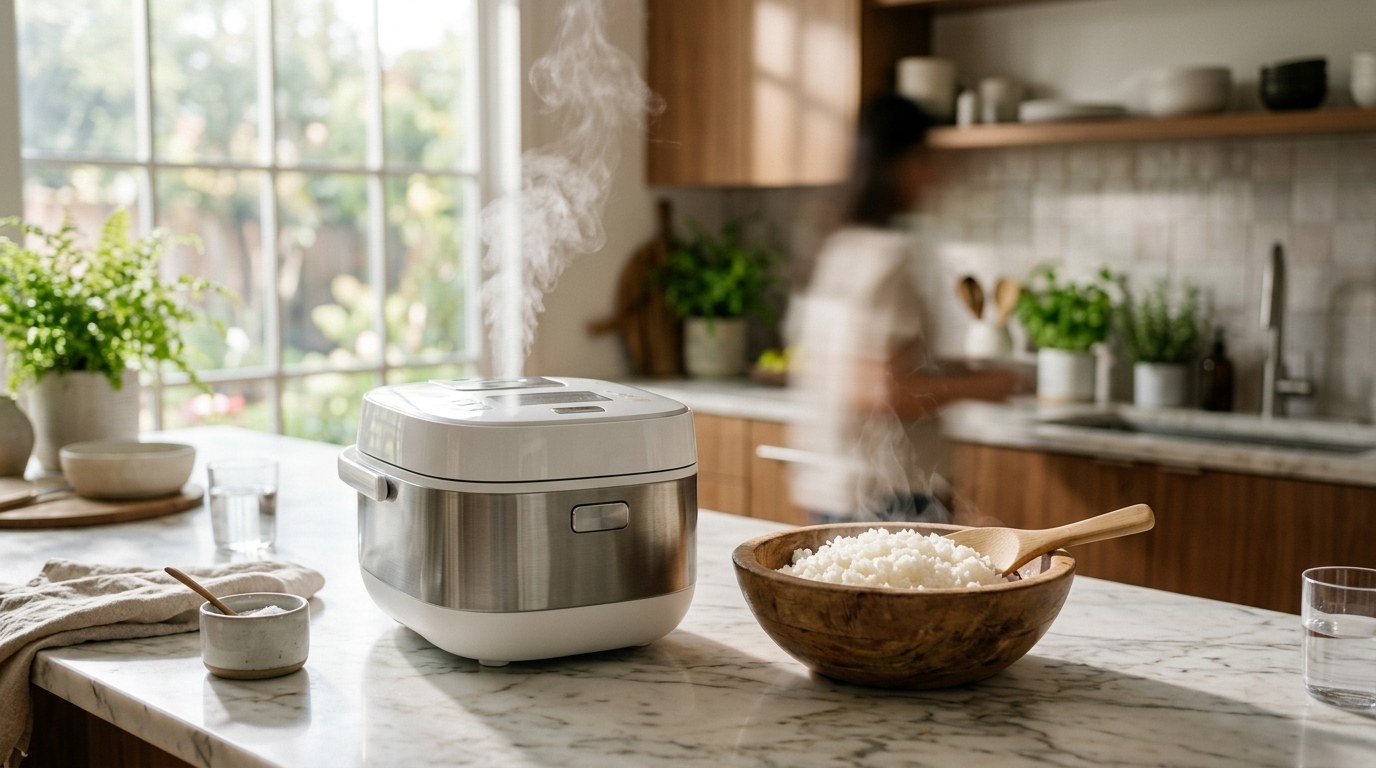
A research-desk guide to Panasonic rice cookers: which US models are actually current, what each tier does, and how the SR-G06FGL and SR-CN108 compare with the import-only SR-ZE185.
Updated October 8, 2026 | Byline: The Fuzzy Logic Review Team
Panasonic occupies a strange corner of the rice-cooker market. The company’s support archive lists thirty-three model designations going back decades — one-button pots, microcomputer cookers, commercial units — but the shelf you can actually walk up to and buy in the US in 2026 is much thinner: essentially one budget cooker, one mid-range fuzzy-logic cooker, and a family of international models that keeps showing up in search results without ever quite being for sale here.
That gap between what people search and what stores sell is why this page exists. If you came in on a “Panasonic rice cooker” search, the honest answer has three parts: what Panasonic currently sells in the US, what the imported models actually are, and which of those (if either) fits your kitchen.
This is a research desk guide, not a test-kitchen roundup. The sources are Panasonic’s own US support and specifications pages, the operating manual for the SR-ZE185, and the two Panasonic models this site has already reviewed in depth. Where a fact is owner consensus rather than a spec sheet, it says so. Where a model could not be verified as a US retail buy, it says that too.
The lineup, sorted by what the machines actually are
Panasonic’s model numbers obscure more than they reveal, so the useful sorting is by heating and control type:
| Tier | Models | What it is | Reviewed here |
|---|---|---|---|
| One-button | SR-G06FGL, SR-G06FGE | Thermostat cooking, automatic shutoff, no sensors | SR-G06FGL review |
| Fuzzy logic | SR-CN108 | Microcomputer control, menu programs, timer | SR-CN108 review |
| Z-family (international) | SR-ZE105/185, SR-ZG105/185, SR-ZS105/185, SR-ZX105/185 | Full microcomputer menu sets, 240V–50Hz electricals | Not verified as a US buy |
| Support archive only | SR-DF101, SR-DE103, SR-JN105, SR-GA series, and more | Older or regional models with support documents only | — |
Two things jump out of that table. First, Panasonic’s current US retail presence lives almost entirely in the bottom two price tiers — the company that pioneered fuzzy-logic cooking does not currently sell a verified induction model in the US. Second, the Z-family’s menu lists look impressive in marketplace listings, but the electrical spec disqualifies them from a normal US purchase, which the next sections cover in detail.
The one-button tier: SR-G06FGL
The SR-G06FGL is the cheapest cooker in Panasonic’s current US line and the most misunderstood, because Panasonic labels it a “rice cooker, steamer and multi-cooker.” Per Panasonic’s own specifications it is a simple one-step cooker: add rice and water, press the lever, and automatic shutoff handles the rest. There is no microcomputer reading temperature curves, no menu of grain programs, and no delay timer.
That simplicity is the feature, not a defect — for a dorm, a first kitchen, or a household of one or two that cooks rice occasionally, the one-button operating model is genuinely hard to misuse. The honest caveats from our full SR-G06FGL review: the inner pan is non-stick coated aluminum rather than stainless, the box includes a measuring cup and scoop but no steaming tray, and the 3-cup-uncooked capacity is not for families. Owners do use it for oatmeal, soups, and vegetables, which is where the multi-cooker label earns partial credit.
If you are comparing small cookers across brands, the same tier contains the Dash Mini and Aroma’s budget pots — the Panasonic’s case is build quality and a see-through glass lid at a similar price.
The fuzzy-logic tier: SR-CN108
The SR-CN108 is the current Panasonic for people who cook rice several times a week and want it to come out the same every time. Its microcomputer adjusts heat through the cycle instead of clicking off at a thermostat trip point, which is the whole practical difference between a $150 cooker and a $30 one: owners consistently report fluffy, separate white rice without gummy bottoms, and a keep-warm that holds rice for a few hours without crusting.
From the full SR-CN108 review: the menu programs cover white, brown, sushi, and porridge; the 5-cup-uncooked capacity suits one- to three-person households; and the two real limits are the absence of induction heating (brown rice is good, not IH-level) and a coated inner pan that is a long-term wear item. The timer is the quality-of-life feature — load the pot the night before, and rice is ready when you wake.
If fuzzy logic itself is new territory, our fuzzy logic vs. Micom explainer covers what the microcomputer actually does during a cycle, and why the cheapest thermostat cookers cannot match it.
The Z-family problem: what SR-ZE185 and its siblings actually are
Search results for Panasonic rice cookers keep surfacing the Z-family — SR-ZE185, SR-ZG185, SR-ZS185, SR-ZX185 and their 1.0-liter siblings — with menu lists that put the US models to shame. The SR-ZE185’s specifications from Panasonic’s own support site: microcomputer control, a 1.8-liter six-layer fluorine-coated pan, eleven menu programs (white, brown, sticky, quick cook, porridge, steam, soup, slow cook, jasmine, multi-grain, claypot), a steam basket in the box, keep-warm up to five hours, and 750 W of cooking power.
Now the disqualifying line from the same official spec sheet: 240V–50Hz. That is the overseas-market electrical configuration. On top of that, the US retail listings this desk checked surface only third-party replacement inner pots marketed as “compatible with” the SR-ZE185 — not the cooker itself as a first-party US offer. Panasonic’s US support site documents the model, which keeps it from being counterfeit-territory, but documentation is not the same as a supported US purchase.
The practical guidance: if you are in a 240V market, the Z-family’s specs are genuinely competitive and the eleven-menu list is real. If you are in the US, a 240V cooker on a US outlet will underperform or worse, and the correct comparison is the SR-CN108 — or a different brand entirely. Do not buy one from a marketplace listing expecting full performance on US power.
Why the brand matters anyway
Panasonic earns its place in rice-cooker history: as Matsushita, the company introduced the first fuzzy-logic rice cooker, the control approach that every mid-range and premium cooker now uses — the story is in our history of the rice cooker. That heritage shows up in the current lineup in specific, practical ways: the removable inner lids that keep starch out of the machine’s guts, the compact footprints (the SR-CN108 is one of the smallest 5-cup cookers around), and entry pricing that undercuts rivals’ equivalent tiers.
What the brand does not currently offer in the US is a premium tier. There is no verified US-retail induction model in the support archive, and nothing positioned against Zojirushi’s pressure-IH flagships. If your search started because you associate Panasonic with high-end Japanese cooking gear, the current US reality is a budget pot and one very competent mid-range cooker.
Matching the model to your kitchen
Capacity is the decision that actually matters, and rice-cooker cups are not US cups — the 180 ml rice-cooker cup is the unit every Panasonic manual and spec sheet uses. Our rice cooker size guide walks the full capacity math; the short version for Panasonic’s line:
- 1–2 people, occasional rice: SR-G06FGL. Three cups uncooked, one button, smallest footprint.
- 1–3 people, rice several times a week: SR-CN108. Five cups uncooked, menus, timer, reliable keep-warm.
- Larger households: neither current Panasonic fits well. The family-size roundup and the small-kitchen picks cover the alternatives at both ends.
For tight counters specifically, the SR-CN108’s compact footprint is its strongest differentiator against same-price rivals — that, not the menu list, is the spec to weigh.
Panasonic against Zojirushi, Tiger, and Cuckoo
The honest brand-to-brand summary: Panasonic wins the entry tier on build quality and the mid tier on footprint; Zojirushi wins keep-warm endurance and the premium tier; Tiger competes hard in the mid tier with the Tacook plates; Cuckoo owns pressure cooking and Korean-style rice. The head-to-heads are in our Zojirushi vs. Tiger comparison, and the full tier-by-tier picture is in the best Japanese rice cookers roundup.
If the choice is between the SR-CN108 and a Zojirushi at the same price, the deciding factors are practical: the Panasonic is smaller and its interface is simpler; the Zojirushi’s keep-warm holds better over long days and the brand’s longevity record is stronger. Both conclusions trace to owner consensus, not lab data — neither machine was cooked with on this desk.
Verdict
For most US buyers searching “Panasonic rice cooker,” the decision collapses to one question: is the SR-CN108’s combination of fuzzy-logic consistency, timer, and compact footprint worth roughly five times the SR-G06FGL’s price? If rice is a several-times-a-week staple, yes. If it is an occasional side dish, the one-button pot is the better spend. The imported Z-family is a specification curiosity for US shoppers, not a buy — its official 240V electrical spec settles that. And if the search was really for a premium induction machine with the Panasonic name on it, that product does not currently exist in the US lineup; the honest move is to compare the Japanese brands that do sell IH instead.
Frequently Asked Questions
Is Panasonic a good brand for rice cookers? Yes, with a positioning caveat. Panasonic (as Matsushita) introduced fuzzy-logic rice cooking, and its current US models are strong at the compact and entry tiers. At the premium induction end the US lineup is thin; Zojirushi, Tiger, and Cuckoo are the safer picks there.
What is the difference between the SR-G06FGL and the SR-CN108? Control type. The SR-G06FGL is a one-button thermostat cooker with automatic shutoff — no sensors, no menus. The SR-CN108 is a microcomputer cooker with menu programs, a timer, and a keep-warm cycle that owners consistently rate. The SR-CN108 costs several times more and suits households that eat rice several times a week.
Can I buy the SR-ZE185 in the US? Not as a normal retail buy. Panasonic’s US support site documents it, but the published electrical spec is 240V–50Hz and the US listings we checked carry only third-party replacement parts. US buyers should compare the SR-CN108 instead.
Does Panasonic make an induction rice cooker for the US market? None that we could verify. The current US support archive lists no induction model, though Panasonic sells IH cookers in Japan. If induction heating is the requirement, the established US options come from Zojirushi, Tiger, and Cuckoo.
Frequently Asked Questions
Is Panasonic a good brand for rice cookers?
Yes, with a positioning caveat. Panasonic invented the fuzzy-logic rice cooker (as Matsushita), and its current US models are strong at the compact and entry tiers. At the premium induction end, the US lineup is thin, and Zojirushi, Tiger, or Cuckoo are the safer picks.
What is the difference between the Panasonic SR-G06FGL and SR-CN108?
The SR-G06FGL is a one-button thermostat cooker with automatic shutoff — no sensors, no menus. The SR-CN108 is a microcomputer (fuzzy-logic) cooker with menu programs, a timer, and keep-warm. The SR-CN108 costs several times more and suits rice several times a week; the SR-G06FGL suits occasional, small-batch cooking.
Can I buy the Panasonic SR-ZE185 in the US?
Not as a normal US retail buy. Panasonic's US support site documents it, but the published electrical spec is 240V–50Hz — an overseas-market configuration — and the US listings we checked surface only third-party replacement parts, not the cooker. US buyers should compare the SR-CN108 instead.
Does Panasonic make an induction (IH) rice cooker for the US?
No current one that we could verify. The US support archive lists no induction model in the present lineup, although Panasonic sells IH cookers in Japan. If induction heating is the requirement, the established US options come from Zojirushi, Tiger, and Cuckoo.
Related Articles
Costco Tiger Rice Cooker: Is the Warehouse Deal Worth It in 2026?
Costco periodically stocks Tiger's JBV-A10U Tacook rice cooker at warehouse-club pricing. Here is what manufacturer specs and verified owner reviews say about the deal, and when Amazon or a Zojirushi upgrade makes more sense.
buying-guidesBest Rice Cooker for Congee (2026): Smooth, Silky Porridge Every Time
The best rice cookers for congee combine a dedicated porridge cycle with fuzzy-logic temperature control and a deep non-stick pot. Here's what to look for and the models that nail silky rice porridge.
buying-guidesBest Rice Cookers for GABA Brown Rice (2026)
Looking for the best rice cooker for GABA brown rice? These induction, pressure, and fuzzy-logic models have dedicated germinated brown-rice cycles that activate GABA and turn tough whole grains tender.